Showing posts with label WebTech. Show all posts

Thursday, June 24, 2010

A Place Called Blogsville (Addendum, Part II)

By way of explanation, all but one the following screen shots below are no longer available in live web page form, but were accessed courtesy of the cached backup archives of The Internet Wayback Machine project, which is, when you can get the archive to actually return an cached site, another of the things that falls into my ‘greatest-thing-since-sliced-bread’ category. Despite the spotty availability of some of the archived site pages and the inordinate amount of time they typically take to load, there isn’t a more valuable resource on the Net in my estimation, and I wish to express my most sincere appreciation to Bibliotheca Alexandrina, International School of Information Science (ISIS) for this invaluable resource!

With that in mind, in referencing our purposes here I experienced only mild success in pulling together the web site archives from the particular points in time I wished to illustrate. Therefore I cannot say with exact certainty when the site messages below first appeared, only that their messages and design updates appeared by the dates indicated.


* * * * *

Every Picture Tells a Story
They say that it’s always darkest before the dawn, and at Pyra, the fire was just about down to a flicker. 2001 brought with it the realization that the company’s six-person crew was about five more than they could afford.

The funding money they had received a year earlier had run dry and some hard realizations had to be faced. After unsuccessfully attempting to market a paid version of Blogger (Blogger Pro) it was decided that the company would remain in business, but that its operations would be drastically curtailed out of necessity. As Pyra’s CEO, Evan Williams would stay on as the company’s only full-time paid staffer.

The Pyra website told the story throughout the process with updated announcements of the company’s status from March 2000 through May 2002; the frequently-changing homepage became a weblog unto itself.
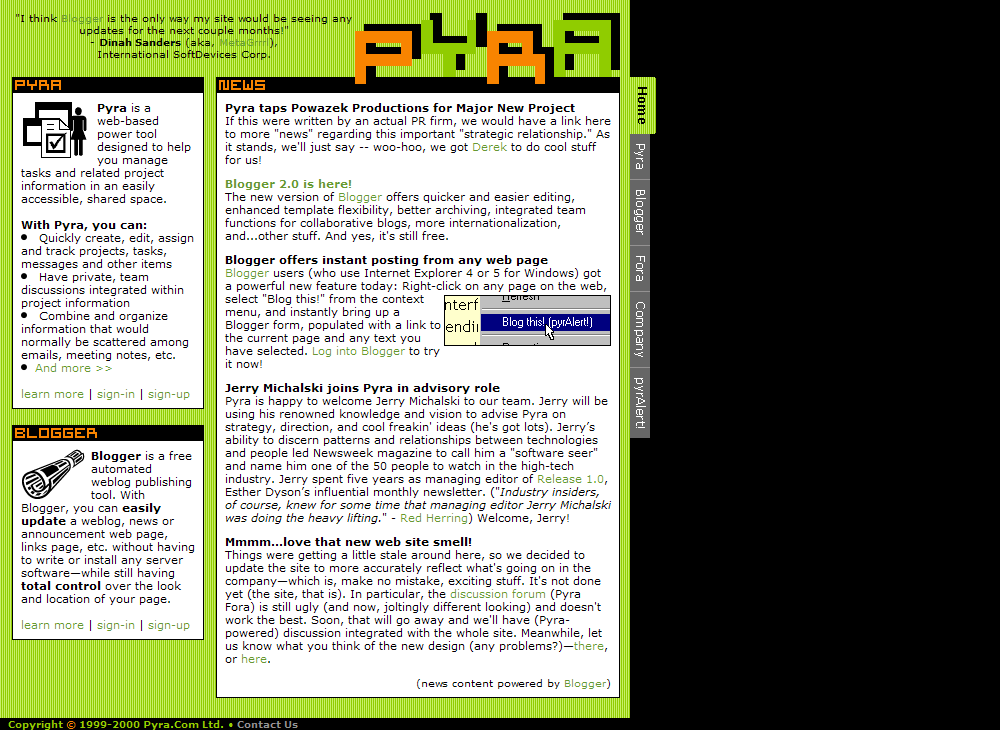
Pyra.com homepage March 2, 2000

This is how the Pyra website looked on March 2, 2000 (click to view at full size); still hawking the Pyra app, but speaking in more and more excited terms about Blogger, which had just reached version 2.0. However the wind had already begun to shift.

Pyra.com homepage May 10, 2000

By May 10, 2000, the website — and the company — was in full re-tool mode, prepping for a full-on, fully optimistic run with Blogger. Oh, and the picture? No, that's not a couple of astronauts in zero-gravity training — it's Meg Hourihan (left) and Paul Bausch burning off some pent-up energy, doing 360s for the webcam. (click to view at full size)
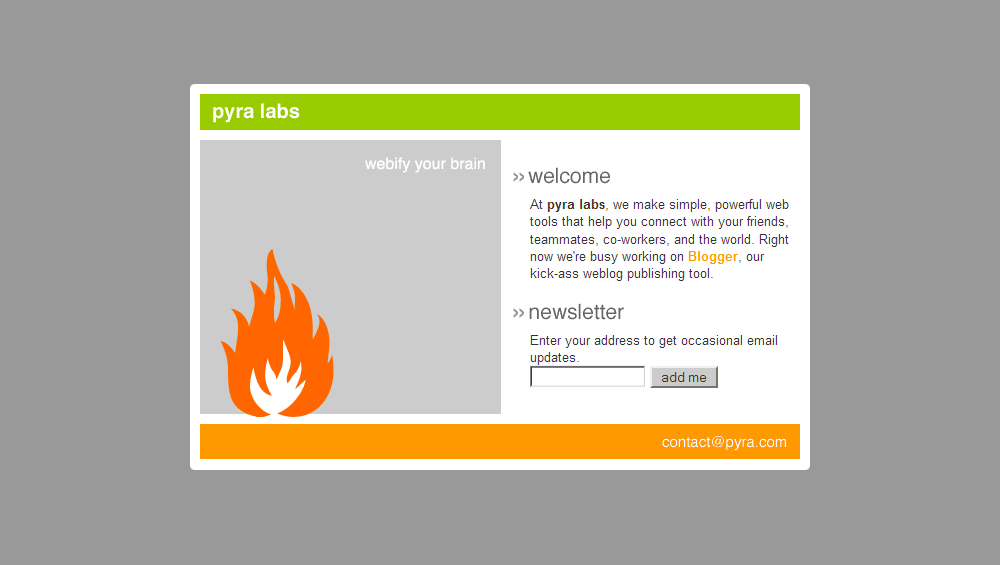
Pyra.com homepage August 15, 2000

By August 15, 2000, a freshly redesigned Pyra.com began the process of distancing itself from itself, literally. (click to view at full size)

However, the ensuing ‘fall’ season would carry with it a double-entendre. The problems would continue for Pyra, but the money would not.
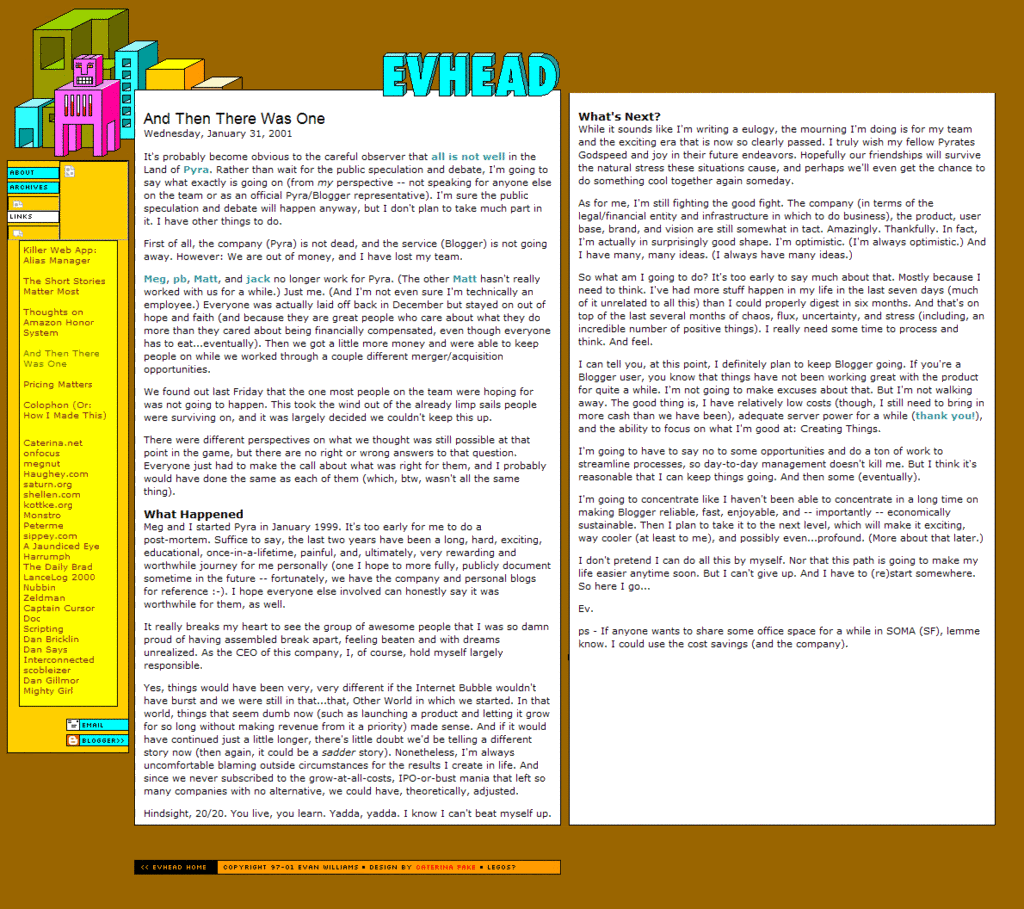
Evhead.com blog January 31, 2001

For “the careful observer” and any other of his friends and readers, who knew where to look, Ev Williams laid it all out in his personal blog, Evhead.com, on January 31, 2001, in an extremely honest and straightforward post entitled, And Then there Was One. (click to view at full size, and in case you were wondering, yes, I did manually photoshop the screenshot into two columns for easier viewing.)

Williams describes in painful detail how the company had laid off all but himself in December, but that some of his team had worked on, for as long as a month for little-to-no pay, in hopes that a new deal with an undisclosed partner would come through. With that reality not panning out he was now going it alone, determined to see things through, to keep the company going, and to continue developing Blogger.
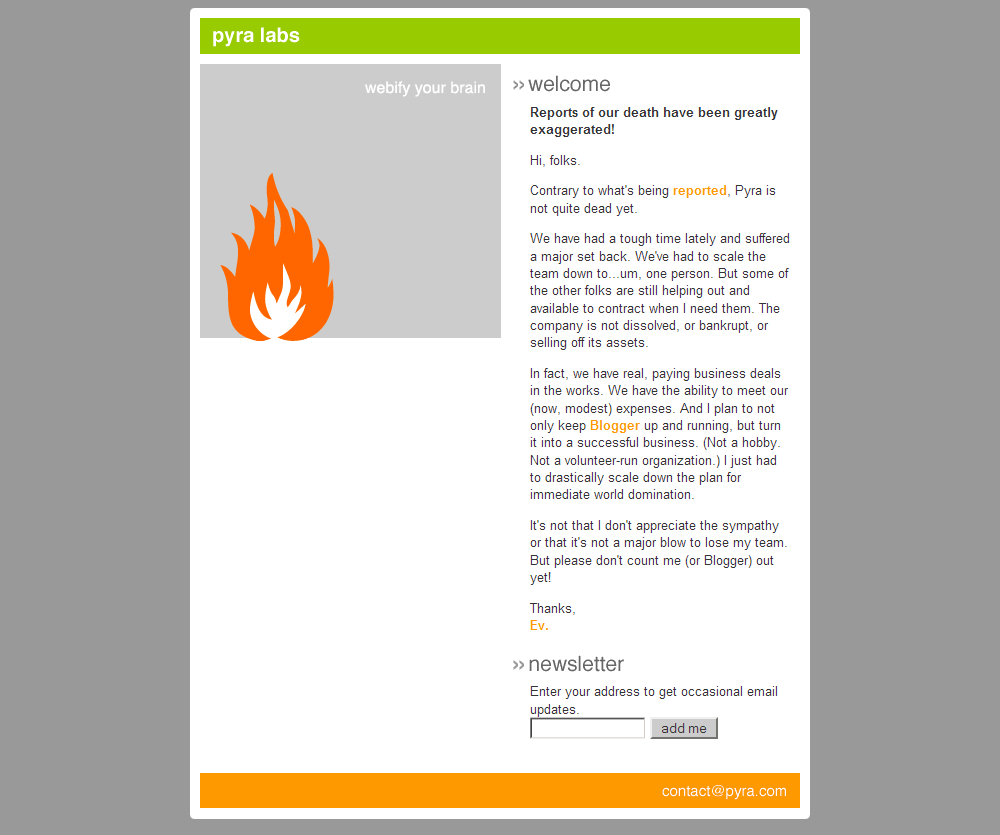
Pyra.com homepage February 2, 2001

In a more public announcement a few weeks later, in this Pyra.com screenshot from February 12, 2001, Williams glibly channels Mark Twain, announcing the news that the company was still in business, but had indeed incurred, “a major set back” (…and we won’t pile on here by pointing out the misspellings either…). (click to view at full size)
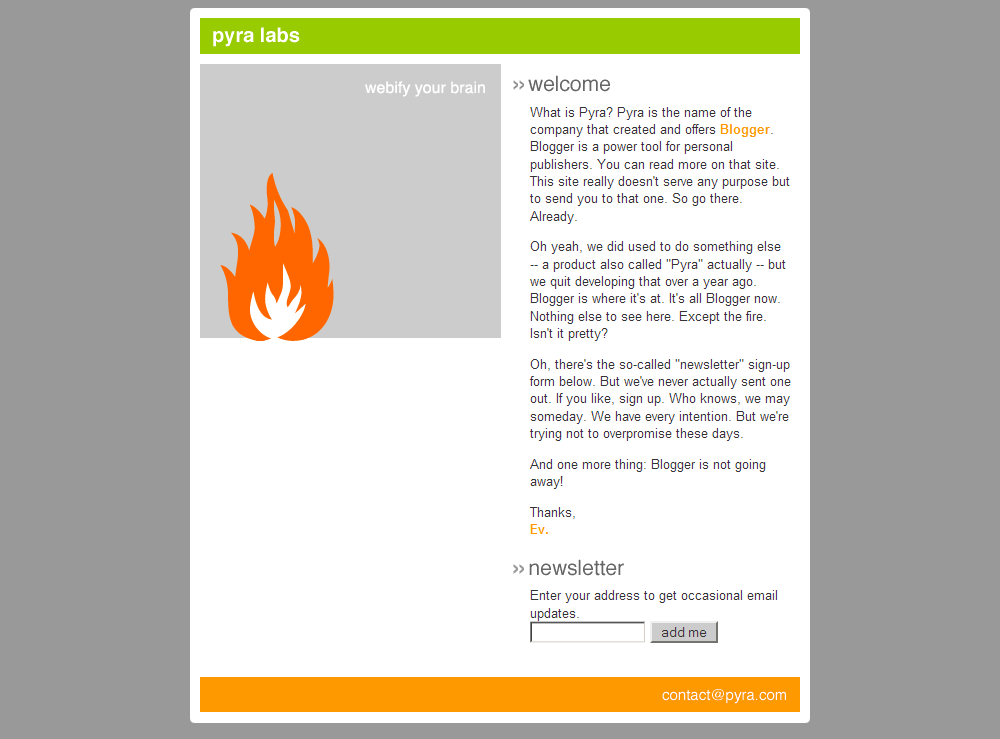
Pyra.com homepage March 30, 2001

More than a year after turning its full attention to Blogger, on March 30, 2001, the website reinforced that there was “nothing to see here” (except for a link to Blogger.com) and that the Pyra application was no longer being developed (click to view at full size).

This iteration of the Pyra.com homepage was also the swan song of the infamous ‘Pyra Newsletter’ signup box. Funny thing is, in the seven months it was in place on the website, nobody ever got around to creating that newsletter they collected all those email addresses for, as Williams sarcastically pointed out.
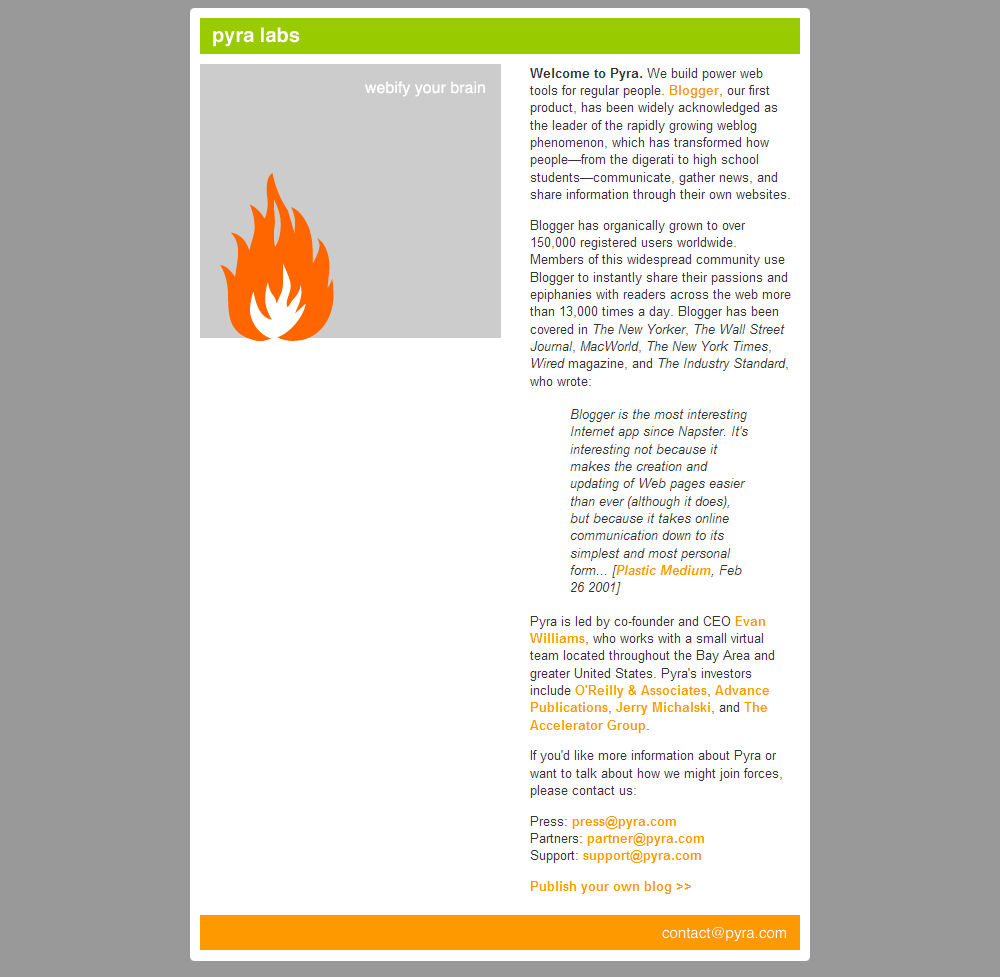
Pyra.com homepage April 18, 2001

Three weeks later, March 18, 2001, the message of Pyra.com is all Blogger and all business (click to view at full size).
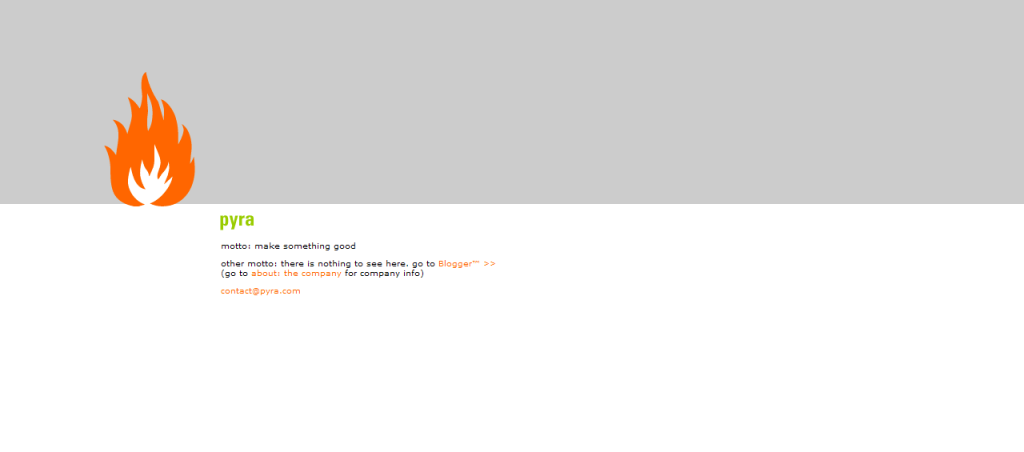
Pyra.com homepage September 16, 2001

By September 2001 The website was again redesigned but remained only as a handbill slapped on the front door of an empty house for another year and a half, with a logo and no other text than that explaining Pyra’s two mottos: 1. “make something good” and 2. “other motto: there is nothing to see here. go to Blogger(.com).” (click to view at full size)
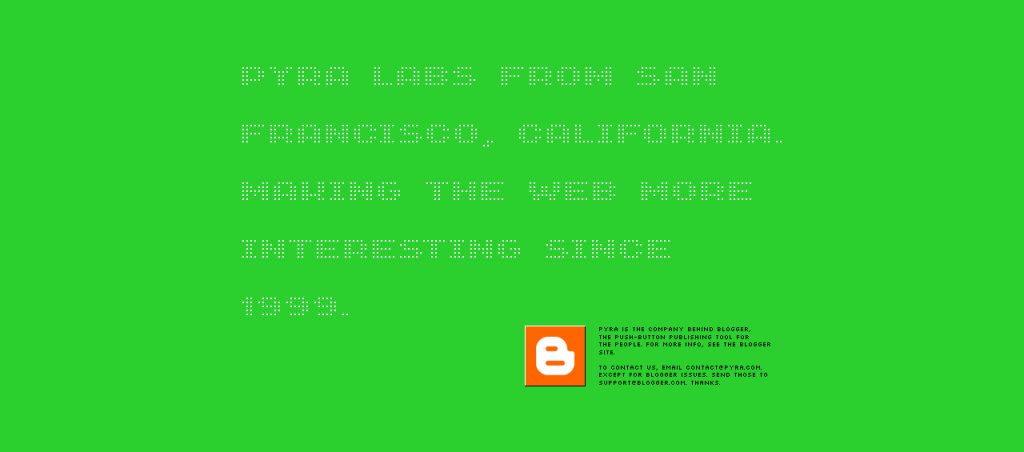
Pyra.com homepage May 24, 2002

By May of 2002, the site had taken on the appearance that has essentially remained unchanged to this day, that of a one-slogan tribute to Pyra Labs, “making the web more interesting since 1999,” along with the iconic Blogger logo link to the Blogger.com website. (click to view at full size)

Addition By Subtraction
However the great thing about this particular sad story is that it ultimately has a very happy ending. As it turned out, Ev and Meg’s little company was just so far ahead of its time that it simply needed to give the rest of the world a couple years to catch up.

For all the heartache and disappointment experienced by the former Pyra Labs crew, the patience and belief exercised by Williams would pay off in spades.

The paring down of staff allowed Williams the time needed to keep the company afloat, while he worked to stabilize the platform and add servers to address the physical load of Blogger’s continually-rising popularity. Along the way he also managed to negotiate a few small business deals, including licensing Blogger to other countries and forming an important partnership with the website-building software company, Trellix in April 2001.

At the end of June, Williams announced a ‘Moving Sale’ to liquidate all nonessential equipment in Pyra’s San Francisco office. He was taking the business home, servers and all, and would operate things from his apartment, lowering the company’s overhead even more. It was no doubt a humbling experience, yet one that Williams seemed to embrace with a more-than-admirable sense of humor. But over the next twelve months things would turn around dramatically.
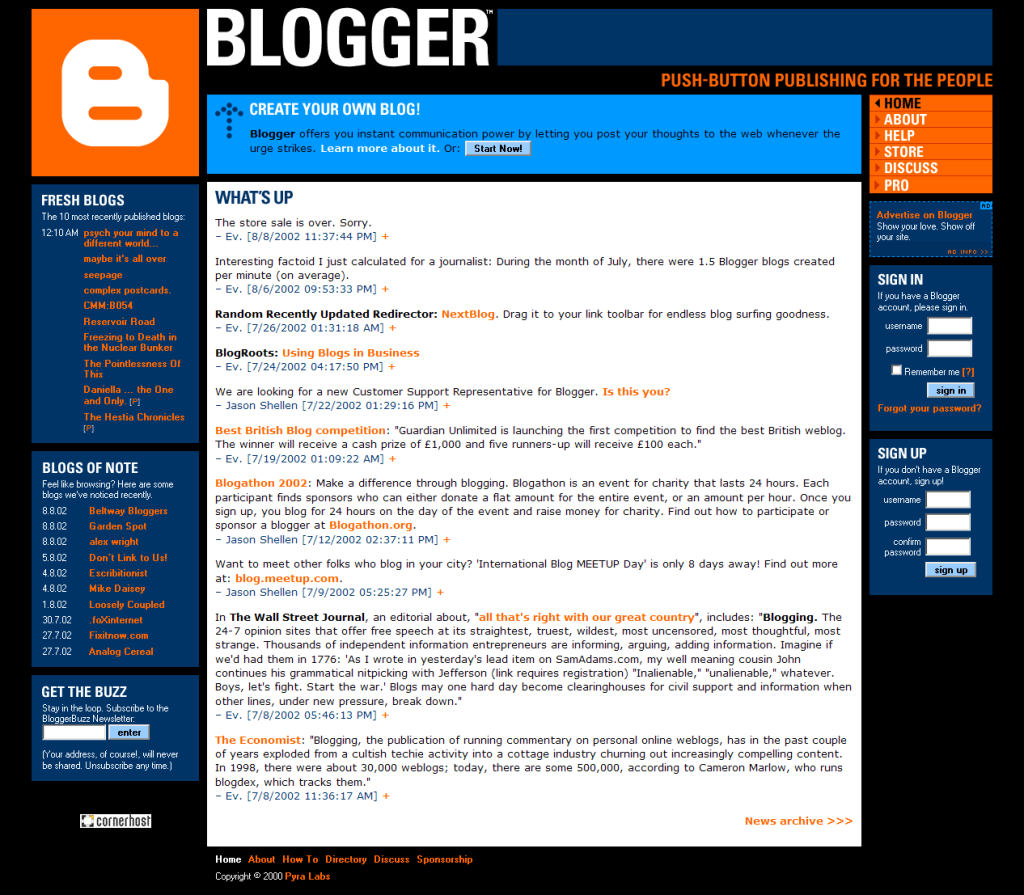
Blogger.com homepage July 23, 2002

By the time I was introduced to Blogger, in the summer of 2002 the homepage looked like this (click to view at full size). Williams’ status blog was brimming with good news, boasting the statistic that Blogger blogs were being added at a rate of 1.5 per minute.

Blogger was co-sponsoring blogging contests with major periodicals, featuring sizable cash prizes; there were ‘Blogathon’ charity events and Blog Meet-ups being planned, along with superlatives about blogging from pubs like The Economist and The Wall Street Journal.

In short, Blogger was riding the cusp of a new wave of a phenomenon that was sweeping the nation and the world. Things had indeed turned around, but the best was yet to come

Yes, They Really DO Like You!
Ev Williams’ Sally Field moment came on a historically poignant date in his company’s history, exactly three years after that game-changing decision to commit to the development of Blogger over his original dream, the Pyra project management tool.

It was February 14, 2000 when Pyra’s initial funding round through O’Reilly & Associates launched the official era of its sole focus on application development, and three years later, it would be on that same date that all the hard work would pay off, in the form of both financial reward and the reality of resources for Blogger’s ongoing product development.

Search Engine giant, Google showed its love, acquiring Pyra Labs and Blogger on Valentine's Day 2003.

Blogger.com homepage July 23, 2002

By the time my TK mates and I moved on to a new messageboard home and I made the decision to venture into the wilds of Blogsville all by my lonesome, the Blogger.com homepage not only had a completely new look, but a new audience as well, with the new Blogger reaching greater heights and exposure than ever before (click to view at full size).

There were newly-created XML blog templates designed under the auspices of Douglas Bowman of Stopdesign, offering the new breed of citizen journalism a place to call home; a place to grow; in an ever-expanding community of newsmakers, journalers, social media mavens, gossip-spinners, mommybloggers and the alike.

Ev and Meg’s Blogger lit the match, but the bonfire of Pyra’s vision was ultimately fueled by Google.

Nevertheless, even a year after the sale, in 2005 PC Magazine honored the success of Blogger and the work of Williams, Hourihan & Bausch (despite the latter two having long since left the company), naming the trio among their People of the Year for 2004.

Still Burning
Ev Williams would stay on with Google for roughly year and a half before again venturing out on his own, first in co-developing Odeo, a search and delivery web service centered on podcast technology, the organization of which would later become Obvious Corp, with a new business partner, Biz Stone.

Odeo was sold to Sonic Mountain in 2006 as Obvious Corp turned its attention to developing what would become the social media dynamo, Twitter in 2007.

Williams currently serves as Twitter CEO while enjoying life with wife, Sara and son, Miles.

Meg Hourihan went on to various other tech projects, including, in the mid-2000s, a joint effort with Gawker Media’s Nick Denton called Kinja, which, by her own description was “one of the web’s first news aggregation sites, an RSS reader without the RSS...a reading tool to make it easier for people to find and read blogs. The other hand of Blogger making it easier for people to write them.”

She is currently between companies, enjoying life as a seriously unpretentious foodie, mother to children, Ollie and Minna, and wife of yet another weblogging pioneer, Jason Kottke.

Paul Bausch, Pyra’s first employee and the man credited with being the Blogger’s primary developer, is still involved in web development at online community MetaFilter in Corvalis, Oregon.

I would again like to thank Meg Hourihan for providing such a well-spoken, thoroughly interesting narrative of Pyra’s increasingly difficult-to-find early history, for use as the basis of this story (and for the honor of her personally proofreading and blessing this post prior to publication).

If you’re a Blogger geek like me, I’m sure you’ll really enjoy the actual audio of that interview, which is still available online as part of Halley Suitt’s podcast series, Memory Lane.

Even though it wasn’t exactly how they planned it, Pyra lived up to their name; they took the weblog flame and fanned it into a bonfire that's still blazing.

Smart technology from some very smart people.

Now a decade later, that motto, do something good kinda seems like an understatement, doesn’t it?


finis

A Place Called Blogsville (Addendum, Part I)

NOTE: I had originally intended the following to be the opening of my little tribute to Blogger. It seemed appropriate to me to introduce my relationship to this medium I love by first introducing those brilliant and inspired individuals to whom we owe its existence.

And while it’s a well-established fact that the more elevated of standing among those who lead the medium today would suggest that Blogger is now passé by comparison to other, more elite platforms, I couldn’t care less. Blogger is special — to me and to millions of its continued, devoted users.

I mean, seriously; say what you want about a product, but in reality, who is more important — the person who refines it, or the one who invented it in the first place?

And because of that, I decided to go beyond cursory mention and give what, based on my research in writing this account, is the most extensive biographical sketch of the company that founded the modern blogging medium: Pyra Labs, and their ‘accidental’ phenomenon: Blogger.


Ev and Meg’s Big Adventure
As large and everyday-ubiquitous as the Web is, currently, it’s hard to imagine that as recently as ten years ago it was a much smaller place.

It was a world of fertile ground, untapped resources, and breathtaking discovery. It was a world prepping for a huge growth spurt.

Once the near-exclusive domain of nerds, geeks, and academia, the phenomenon of ‘weblogging,’ originally born very early in the decade of the 90s, emerged from its infancy with the growth and popularity of the HTTP-encoded World Wide Web, popularized by the Net’s first graphical browser, Mosaic in 1993.

Blogger.com founders, Ev Williams, Meg Hourihan, & Paul Bausch
Blogger.com founders (from left), Ev Williams, Meg Hourihan, & Paul Bausch.
However it was nearly ten years later before the team of Evan Williams, (yes, the same Ev Williams, who would later co-found Twitter), and business partner, Meg Hourihan, would spur the medium to the new heights we know today.

In a wonderfully informative podcast interview she gave to the website, IT Conversations back in 2005, Hourihan discussed the beginnings of Blogger.com — the blogging portal that she, Williams, and Paul Bausch developed — almost by accident.

According to the interview, Williams and Hourihan formed Pyra Labs in 1999, operating out of the latter’s San Francisco apartment.

Their new company’s original goal was to create a web-based project management application targeted at web developers to improve upon the often cryptic and inflexible Microsoft Project. They wanted to come up with an online tool that would make the process of updating a project plan easier and more immediate —across cyberspace as opposed to the more static constraints of updating a physical MS Project file and then distributing it via email or FTP.

Interestingly, what would become Blogger was a sideline component developed in the midst of that effort, which was essentially a ‘throwaway’; a free feature intended to entice potential buyers to purchase their primary product.

Instead, the sideline overtook the mainline.

It is significant to recall that 1998-99 was the crux of the dot-com boom’s initial period of rapid ascension. Thousands of enterprise web sites were being created at that time, often by teams of developers scattered across the country. The Pyra Project’s main focus was to make the management of such efforts easier, more accessible, and more immediate.

It was a great idea, but it spawned an even better one in the process.

BlogStuff
While working in the same room, but not wanting to disturb each other with interruptions to present new ideas that might pop into their heads throughout the day, Hourihan said she and Williams created a simple, internal weblog, aptly named, ‘Stuff.’ Its purpose was to register brainstorming thoughts and other flashes of enlightenment that either one might come up, but in so doing, not disturbing the flow of work in the office.

They later decided that including a similar weblog feature as a standard component of the Pyra application would be a beneficial value-add for their customers, just as it had been for them in developing it.

However, as Hourihan recalled, “through a bunch of…random happenings,” the server that hosted the ‘Stuff’ weblog was a different one than that which hosted the Pyra.com site itself, which had a separate weblog as well.

This would be a problem should they wish to avoid the extra work of posting an entry in both places. So later, for purposes of both internal and external communications, to solve the problem they tasked Pyra’s first employee, developer Paul Bausch, with creating some code that would allow entries written to the ‘Stuff’ weblog to automatically appear the on pyra.com weblog as well. As Hourihan explained, Bausch’s code would become the foundation upon which Blogger was built.

Hourihan described the Blogger ‘Ah-HA’ moment thusly: “Hey, this is kinda neat! You can write something in one place, and it’s appearing in another place.”

But again, the key intent was not to develop a blogging platform, but rather to use this new innovation as an inducement to market the bread & butter Pyra app.

As Hourihan described, the bulk of weblog users at that time were the indeed Pyra’s target audience: web developers. The hope was that once the developers saw how much easier this new ‘push button’ method of weblogging could be, they would then in turn be inclined to believe that Pyra was a cool company that they would want to do business with; purchasing the Pyra project management software tool for use on their web projects, and in general, making the world a better place for everyone.

Som’ ‘bout the plans of mice and men oftentimes going awry…?

By the first quarter of 2001, however, much had changed in the world of emerging web companies. The DotCom boom began its steep slide into full bust mode. Times grew tough for San Francisco internet startups like Pyra.

Pyra’s "Team Implosion"
A change in direction had actually begun a year earlier, in the winter of 2000, when team Pyra, then consisting of four members, decided to seek outside funding for the first time.

The Pyra project management app was still struggling through development. Mucking up the waters further was the fact that the company was actually being supported via contract work relationships that Ev Williams had brought with him from his previous freelance career. One developer worked full-time on the outside contract jobs while the other three continued developing the Pyra app and Blogger.

This model of self-funding “just wasn’t gonna scale,” recalled Hourihan, “unless we kept hiring people to do client work, and that wasn’t really the type of company we were interested in building; we didn’t want to do professional services; we wanted to build really cool web applications.”

Fortunately, by this time, the contacts and reputation that the company was creating, along with the ongoing relationship Ev had with a former employer, O’Reilly & Associates, allowed Pyra to acquire the seed money it needed to really sink its teeth into its work. They could now dispense with the unrelated contract work they’d needed just to make ends meet. It was the opportunity to finally be the company they wanted to be.

The initial funding round for Pyra began on February 14 — Valentine’s Day, 2000; for the company it would be a significant spot on the calendar, not only at that time, but later on as well.

They decided to suspend work on the primary Pyra app, and focus on Blogger, the former spinoff that ironically was receiving increasingly rave reviews, and in fact became Pyra’s first officially released product.

They would build out the team, adding another two people, bringing the total compliment to six, and as Hourihan put it, “see what we could do with it,”

However not all would go as planned. Over the next eleven months the DotCom bubble would finally burst, sending tech stocks tumbling and bringing most startups to their knees, financially. Most tech development went into a deep freeze.

At the same time, from the opposite end of the spectrum, Blogger was facing its own problems. The platform’s tremendous popularity created more traffic than their existing servers could handle, leading to lapses in reliability. New features weren’t being added fast enough, leading to more customer complaints, including, ironically, one that led directly to the development of what would become one of Blogger’s chief competitors, Movable Type.

Mena Trott and her husband, web developer Ben Trott, created Movable Type as an answer to Mena’s frustration over Blogger’s period of arrested development in 2000.

Trott, originally a Blogger enthusiast, confided in Hourihan that she felt such loyalty to Blogger, that she couldn’t bring herself to use a competing product, so she decided to develop one for her own personal use. That effort, designed by Mena and coded by Ben, worked out so well that within a year the Trotts indeed decided (at the insistence of their other friends) to market it as a competing product.

Later, under the umbrella of their new company, Six Apart, the Trotts would additionally develop two other varietal blogging platforms: TypePad and Vox, in addition to the premium Movable Type.


Next: Addendum Part II: Every Picture Tells a Story

Tuesday, March 16, 2010

I Think Dylan Would be Proud

No...not THAT Dylan.
I’ll be expanding on this post later, when I have time, but now I’ve got a bunch of stuff I need to take care of in my offline life. I just wanted to take a minute to let those who care about this place know that at long last, actually two full years after beginning this project (and nearly four years after I was goaded into doing it), I have finally upgraded the design of my blog’s template, and will hopefully follow suit in my overall goal to upgrade my presence in this place that has been such a special part of my life for the better part of a decade.

Please look around and note the new, static pages in the horizontal navigation bar above. Two of the pages are merely updated versions of the linked info pages I had hosted myself before, but which now are a part of the blog itself, thanks to Google/Blogger finally adding the feature that Wordpress users had enjoyed for years.

For those previously unfamiliar, the ‘About’ and ‘Greatest Writs’ pages are, respectively, an introduction to my blog and a little bit about me, and a self-appointed ‘best of’ list of the posts I've written over the years about my life, family, and experiences.

Additionally, there are two new pages. ‘What Happen?’ is the definitive recap of how this blog got its name. I've also added a brand new Contact page, with a form from which you can throw out a general comment or message not necessarily pertaining to a post. This is also a great place to call me to the carpet on a typo or other unintentional misinformation that might have slipped through my fingers. I appreciate constructive criticism and welcome any other general comments you might have.

Still Workin’ on it
There are a couple of features that are still under construction, but which will both be completed soon. One is already on display: the Archive Story Index is a long-standing feature I added a few years ago, but haven't done a very good job of keeping current. It now it lists each AYBABTU post from May 2004 through the end of 2007, but I’ll be bringing it up to date shortly.

I'm also in the process of adding a detailed ‘Faves’ page, which will include a blogroll and site description of all my favorite folks on the Net, both from the ‘old neighborhood’ of Blogger.com, as well as the new friends I’ve made in the last couple years through my involvement with the hockey blogging community and on the social media phenomenon that is Twitter.

All that said, I hope you like the new AYBABTU. It’s been a long time coming, but for me, anyway, it's been worth the wait.

finis

Friday, August 07, 2009

Dood...We Were Jobbed.

Say it Ain’t So, Joe(job)
If you’re a fan of micro-blogging medium, Twitter, I think you’d agree that yesterday morning was just a bit of a bummer. Our Daily Affirmation-in-a-(Dialog) Box was wrested from us for better than six hours (depending on your locality) by what was originally assumed to be a coordinated DDoS (Distributed Denial of Service) attack on several social media vehicles, including Twitter, Facebook, LiveJournal and YouTube, but which is now believed to actually have been directed at silencing the political views of one individual; a well-known anti-Russian blogger, who has been particularly vocal in his criticism of the Kremlin’s policies toward the Republic of Georgia. I actually found that somewhat easier to stomach than the usual ‘because I can’ reasons many hackers choose as motivation for their mischief.

But politics aside, what I found most appalling of all wasn’t the kill-the-fly-with-a-hand-grenade approach that was taken in carrying out their mission, but rather the mindless assist these hackers got from the general public in accomplishing it.

This was no a sophisticated surgical strike of technical programming prowess, folks. It was a freaking ‘Joe job.’

What’s a ‘Joe job?’ you ask? Well the term was a new one on me too until I read this newsflash from the British IT website, The Register. To quote the author, “Joe jobs are spam messages that are designed not to push Viagra but to induce someone to click on a link in the hopes of harming the site being linked to.”

Sounds harmless enough. I mean, we’ve all received and deleted hundreds of these spam emails over the years; even more that we don’t see are corralled by our email client’s spam filters. But should one or two a day slip through, we know not to even open them, much less click on the links they offer, right? I mean what are we, stupid?

Um...weeeel...

Dis and DDoS
DDoS attacks are usually performed by malicious software (or ‘bots’) exacting furious request activity on a particular web site or service, over a short period of time; the result being overloaded servers and the target site being rendered inaccessible. Since DDos bots can’t be everywhere and thereby are traceable by IP address, their attacks are usually short-lived. However in this case, the attackers were people all over the world — who didn’t even realize they were attacking. And when thousands of people worldwide click the same links at essentially the same time, the impact is virtually impossible to combat; you just have to wait it out and hope that the damage of being out o’ commission was minimal.

So there you have it. What we thought were the coordinated efforts of cunning hackers in the shadows, perhaps making a power statement on the highly visible stage of the social media Web, now appears to have actually been an old-school, comparatively unsophisticated attack that became insurmountable only through the unwitting collaboration of thousands of know-nothing link-clickers in broad daylight.

The Register article explains:
"This was not like a botnet-style DDoS; this was a joejob where people were just clicking on links in email and the people clicking on the links were not malefactors. They were just the sort of idiots that click on links in email without knowing what they are."
Bill Woodcock, Research Director, Packet Clearing House
Now I don’t know about you, but THAT pisses me off a helluva lot worse than the thought of some pimple-faced hacker dude, holed up in his Mom’s basement, hatching a plan to receive his fifteen minutes of fame.

But whatvs. People either get it or they don’t. But if they don’t understand the implications of their carelessness now, will they ever learn?

When will folks understand that clicking on links in emails you receive from unknown sources just to see where it goes is about as smart as sticking your finger in a light socket just to see if it’s on?

♫ And I get on my knees and pray...We won’t get fooled again ♪
Y’know, I can’t help but think the person or persons who actually launched this joe job are feeling like they just won the lottery. They must be bustin’ their buttons over their unexpected brilliance right about now. I mean this has gotta be better than Christmas for these guys.

Not so much for the rest of us, however.

Traditional DDoS attacks can be mitigated. User carelessness/stupidity cannot.

You don’t think other would-be copycat hackers are taking notes here? I mean, c’mon people.

Look before you leap.

Think before you click.

Google before you ogle.

This scenario could (and likely will) be repeated. It’s up to us to defuse the idiot-bomb before it explodes on our faces again once again.

WE caused Twitter, Facebook and the others to go down.

WE were the ones who made Joe Hacker’s job easier than it should have been.

And WE can be the ones to keep it from happening again.


finis